
News
Project Information
Project Name:
Tick-borne bacterial infections in urban areas - where does the real risk of infection lurk?
Project Goals:
The main objective of the project is to map the risk of human infection with selected tick-borne pathogens in such urban habitats in the Czech Republic, which in principle allow the establishment of independent tick populations.
Project Duration:
Implementation years: 2023 - 2026
Duration: 4 years
Project Description:
Ticks can transmit many pathogens that cause serious diseases in humans and animals. This health risk is primarily associated with visits to forests, which are the natural habitats for ticks. However, ticks and tick-borne diseases can also be found in towns and cities, wherever the conditions are right: in parks, woodlands, gardens or cemeteries. As the frequency of human movement is significantly higher in cities, and few people think to use repellent before visiting a park or to check for ticks after returning from the garden, urban green spaces represent areas with increased risk of infection with tick-borne pathogens.
Within the project "Tick-borne bacterial infections in urban areas - where is the real risk of infection?", funded by the Programme for the Support of Applied Health Research, Ministry of Health of the Czech Republic, we are investigating how many ticks actually occur in urban environments and what pathogens they carry. An equally important part of the project is also an effort to find ways to reduce the occurrence of ticks so that we can enjoy our visit to the park or garden without worry. Experts from the Institute of Parasitology of the Biological Centre of the Czech Academy of Sciences in České Budějovice, the National Institute of Public Health in Prague and VSB - Technical University of Ostrava are cooperating on the project.
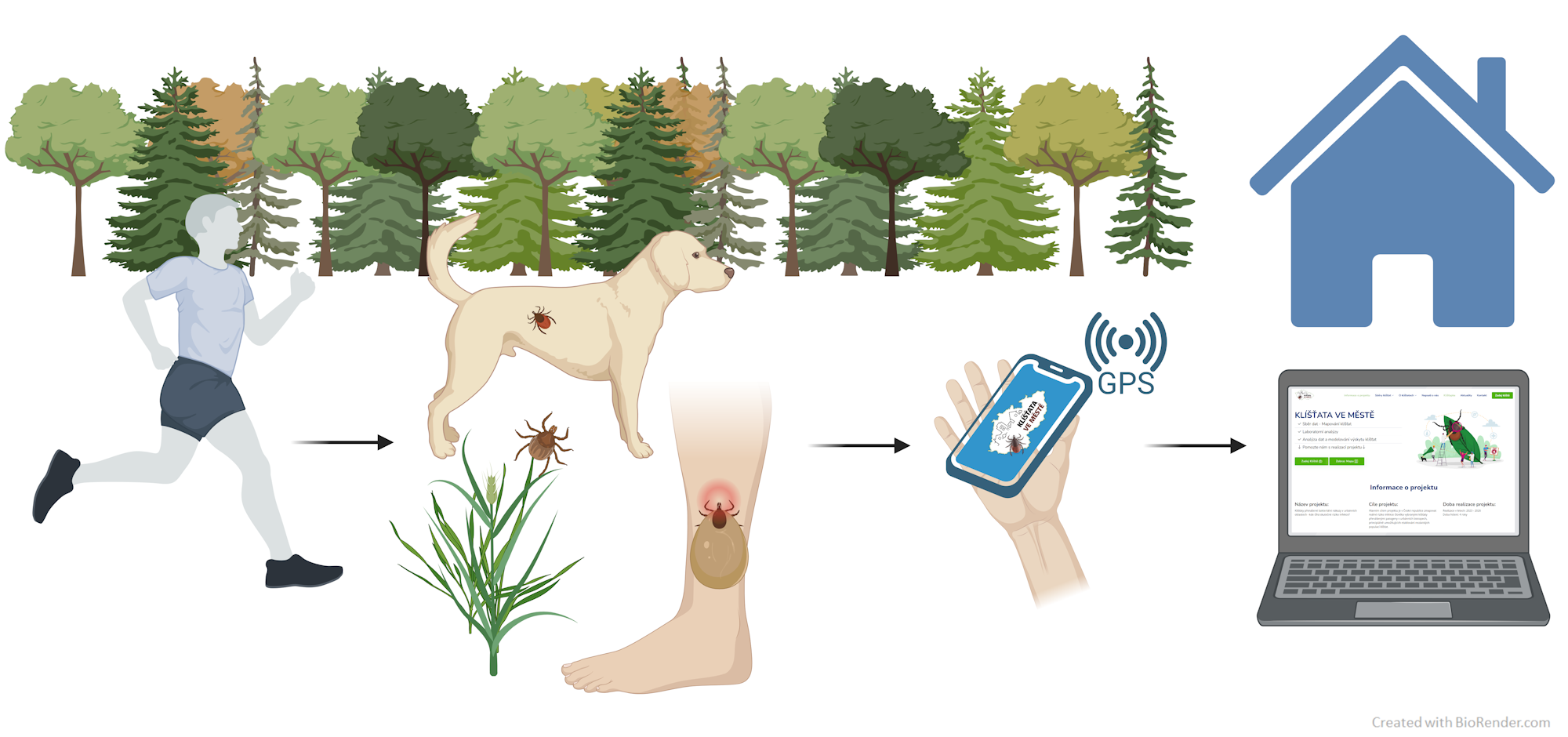
Do you want to help us with our research?
Based on field and laboratory data and mathematical models, we can predict tick activity and the likelihood that a tick will carry one of the pathogens that infect humans and animals. However, it is not yet clear where people most commonly encounter ticks. You can help us get this unique data by reporting ticks you encounter questing on vegetation, crawling or attached to you or your pets. We are interested in ticks from cities as well as from the wild from the Czech Republic and elsewhere. Please, REPORT TICKS - you will help science, thank you.
More About the Project:
Within the project we continuously monitor tick activity in selected parks and forest parks in Prague, Ostrava and České Budějovice. We also collect ticks once a season in all remaining 10 regional cities in the Czech Republic. In order to compare different locations, we express tick activity as the number of ticks found per 100 m2 of sampled area. In the areas of urban green space we monitored, tick activity last season ranged between 0.1 ticks per 100 m2 and 72 ticks per 100 m2. It is not without interest that we found active ticks even in the warmer days of December, although these were only a few individuals (detailed results on the maps here).
In laboratories, we use DNA analysis to look for bacteria in ticks that can cause serious diseases in humans and animals. Specifically, we target the bacteria causing Lyme disease (Borrelia burgdorferi sensu lato), a related species of Borrelia causing relapsing fever (B. myiamotoi), the causative agent of anaplasmosis (Anaplasma phagocytophilum), neoehrlichiosis (Neoehrlichia mikurensis) and the bacteria causing tick-borne rickettsioses (Rickettsia sp.). Initial results of the project show that in many cases the percentage of infected ticks is comparable or even higher than in forest habitats, the natural habitats of ticks (detailed results on maps here).
We are also trying to identify the conditions under which tick populations and the bacteria they carry thrive or fail, so that we can design procedures to minimise the risk of infection. Specifically, the location, size and landscaping of parks, the range of hosts on which ticks feed in parks, etc.
Project Financial Support:
AZV ČR - Czech Health Research Agency
Ruská 2412/85, 100 05 Praha 10
Principal Investigators:
Mgr. Václav Hönig, Ph.D.
principal investigator
Biology Centre CAS, v. v. i.
doc. RNDr. Pavel Švec, Ph.D.
co-investigator
VSB - Technical University of Ostrava
Ing. Martin Kulma, Ph.D.
co-investigator
National Institute of Public Health Prague
Project Collaborators:
RNDr. Kateřina Kybicová, Ph.D.
National Institute of Public Health Prague
Ing. Terezie Arnoldová, Ph.D.
National Institute of Public Health Prague
Mgr. Eva Richtrová, Ph.D.
National Institute of Public Health Prague
Mgr. Jiří Navrátil
National Institute of Public Health Prague
Ing. Pavel Kukuliač, Ph.D.
VSB - Technical University of Ostrava
RNDr. Jan Kamiš
Biology Centre CAS, v. v. i.
Klára Lengálová
Biology Centre CAS, v. v. i.