How are the ticks collected?
For most of us, ticks are an "annoying parasite" that also transmits diseases, and unfortunately it sometimes happens that we unwittingly feed this foreign invader with our own blood. But what to do if, on the other hand, we crave as many ticks as possible, to examine them in the labs?
In short, it depends mainly on the biology of the tick species in question. Some ticks seek out their hosts actively and can therefore be attracted to carbon dioxide or other attractants. Other species live covertly, tightly bound to their hosts. These ticks are either attached to the host or hidden in their nest or burrows. Such ticks live in our country, but the average person does not come into contact with them. If we need representatives of these species, we have to take them directly from the trapped hosts or from their nests.
The third option uses the species of tick that we encounter most often in our nature, the common tick (Ixodes ricinus). This tick seeks a host by climbing onto low vegetation and waiting at the end of a stalks or twigs in a typical pose with the first pair of legs outstretched for a suitable host to walk by and pick it up from the vegetation. This behaviour is exploited in tick collection by a method known as flagging. This technique involves using a piece of white cloth (with a thick longer pile, e.g. technical flannel) mounted on a stick to swing across the tops of low vegetation. After a few metres, the 'flag' is reversed and the captured ticks are moved with tweezers into tubes. This method has various modifications, ranging from flags of a few decimetres squared, which are used for rugged terrain, to collection by means of large blankets towed by all-terrain vehicles across the steppe.
The advantage of this method is that in addition to obtaining valuable tick samples, we can also determine how many ticks are active in a given area at a given time - expressed as the number of ticks per 100 m2. You can also find these numbers in our results in the "Where we collect - map" section and get an idea of the risk of encountering a tick in a given place. Tick activity changes very dynamically depending on a number of factors such as season, current climatic and microclimatic conditions, etc.
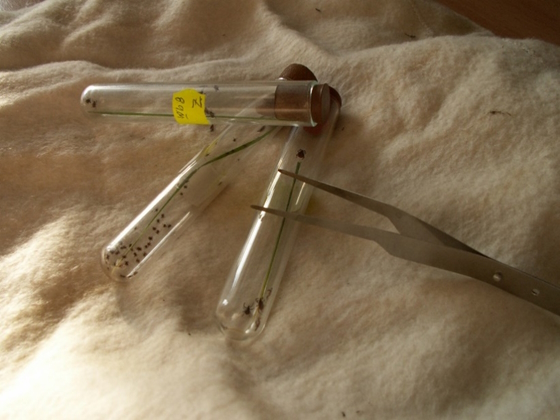
Collected ticks (nymphs and adults of the common tick) are placed in tubes with a piece of grass to maintain suitable humidity inside the tube. In this state, the ticks can be kept alive for several weeks, ideally in a refrigerator.
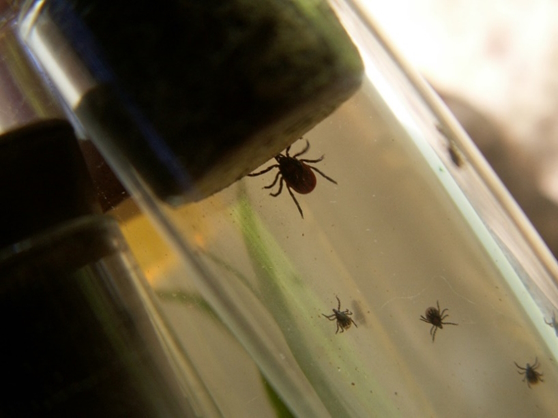
Collected ticks: adult females (larger tick on the far left) and nymphal stages (smaller ticks near the right side of the photo) of the common tick in test tubes.
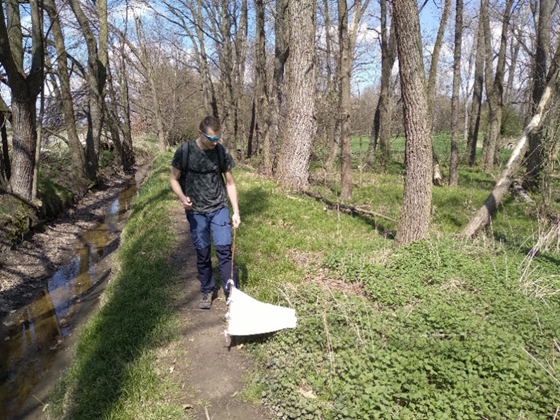
Sampling of ticks by flagging. Ticks lurking on vegetation are caught on a flag from which they are then collected into tubes with tweezers.